the beginning
Towards the end of the 1850s, relations between Britain and France became strained, to the point at which it was feared that France might launch an invasion. The Crimean War and the Indian Rebellion had shown that vast numbers of British soldiers could be drawn into distant conflicts, leaving the British Isles unprepared for a war closer to home. The solution to this was the Volunteer Force (composed initially of Rifle and Artillery Volunteers) of 1859, a stay-at-home army of part time soldiers, drawn from the civilian population and trained to use the relatively new P53 Enfield rifle. Having been introduced only 5 years earlier, the Enfield rifle brought about a significant change in the way the armed forces trained and fought. No longer were rifles solely to be used by elite units, such as the Rifle Brigade, but were rolled out across the entire force, meaning that every soldier was now a potential marksman. The new rifle allowed soldiers to shoot accurately at great much greater distances than was achievable with the Land Pattern Musket (commonly known as the Brown Bess), a smooth bore weapon, firing a round lead ball. The rifle required soldiers to invest significant levels of training, to achieve the potential. With the setting up a School of Musketry at Hythe (the term ‘musketry’ hung around for another 50 years), Britain was suddenly leading the world with its rifle training. Selected individuals would go on a two week course to Hythe, returning to their units to disseminate the information. This was the world into which the rifle volunteers emerged, outfitted with what was then a cutting edge weapon.

P53 Enfield rifle.
On the 12th May 1859, the Volunteer Force was officially encouraged by the Government and the enthusiasm for the Rifle Volunteers spread rapidly, with corps being set up all around the country.
Writing in his diary on the 28th May 1859, Rev. John Goring, son of Charles Goring, Baronet, of Wiston House, noted that on his walk to the Steyning Holt (area of woodland west of Court Mill and north of Pepperscombe Farm) that the valley beneath the Holt would make a ‘good practice ground for Riflemen’ (with thanks to Richard Goring for this reference). In that single sentence the future of the valley as a rifle range was set for the next 120 years.
The formation of Steyning and Henfield RVC was discussed one month later, in a meeting at the White horse Inn (June 23rd 1859). Charles Goring was in attendance, elected as chairman, but the meeting was thinly attended and adjourned to a later date. On the 2nd January 1860 a further meeting was held to gauge public opinion to a local Rifle Volunteer corps – the response was positive and the ball was finally rolling. It was not until May 1860, however that the company was approved and became an official entity, the 18th Sussex Rifle Volunteers (in the time it took to muster enthusiasm in Steyning and Henfield, 16 other corps having already been formed). Charles Goring seems to have thrown in his hand with the 8th Storrington Rifle Volunteers and became their Captain in February of that year, while the leadership of the Steyning and Henfield Volunteers was claimed by Percy Burrell, of Knepp. Rifle ranges were crucial for corps of Rifle Volunteers to gain official acceptance and each had to provide their own range to practice on, a place that was safe for both the novice shooter and the civilians in the neighbourhood. Hundreds of rifle ranges appeared all over the country and Steyning rifle range was just one of these. The potential that Rev. John Goring had seen in the valley below the Holt had come to fruition.
18th Sussex Steyning and Henfield Rifle Volunteers
The first recorded reference to the range at Steyning comes on October 9th, 1861 in the Sussex Express. ‘PRIZE SHOOTING – On Thursday 10th inst., the 18th Sussex Rifle Volunteers met at their beautiful shooting ground, the Holt, near Steyning, for prize shooting and the day was all that could be desired’. Members of the 18th are seen to be not just from Henfield and Steyning, but Ashurst, Nuthurst, West Grinstead and Southwater too. Corporal Goacher made the best score and was nominated by Captain Burrell to attend the School of Musketry at Hythe. Mrs Burrell distributed the prizes and gave a speech congratulating everyone present commenting that if the 18th stay focused on their drill and musketry they will be second to none in Sussex.
The rifle range at this time was very different to the one that we see today. The 25 inch Ordnance Survey map of 1875 gives an indication of how the range was laid out, despite being 15 years old by this point.

1875 25 inch Ordnance Survey map.
The single target (one target meant just one person shooting at a time) was located much further up the valley slope than the current targets, the map labelling this erroneously as ‘Butt’.
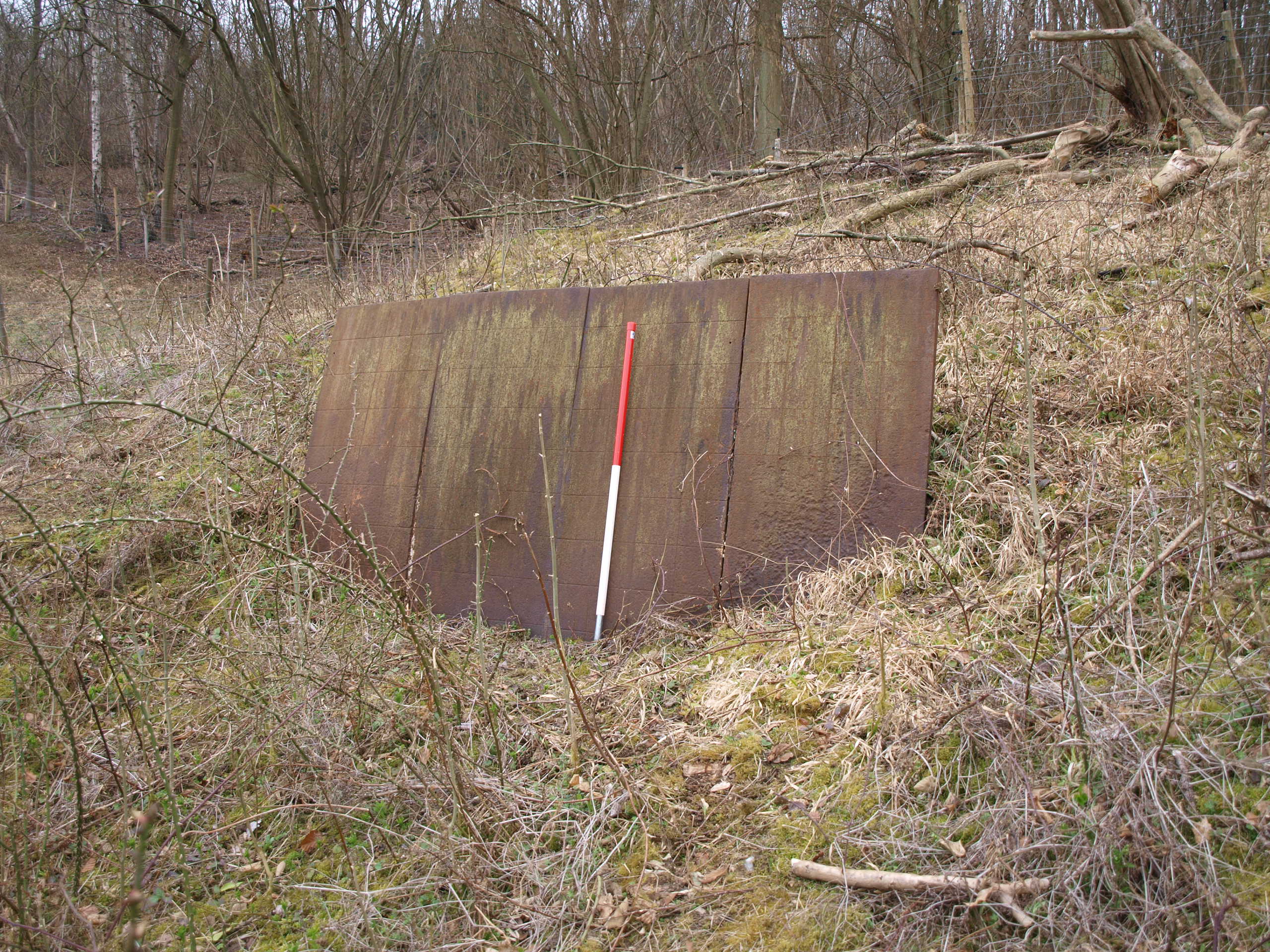
This iron target (four plates bolted together) is from the rifle range at Shoreham, Kent, but are the same type that would have been used at Steyning.
The ‘Mantelet’ (the spelling of which should be Mantlet), shown south-east of the target, was the position that the marker would be placed in, to indicate the impacts of the bullet strikes by a system of flag marking. He was protected from bullets by an iron box, closed on three side, with the side facing the target open, a bench being provided, for comfort. Mantlets could also be made out of masonry with a protective earth bank, but the steeply rising ground in this part of the valley would have made the iron box a much simpler proposition.
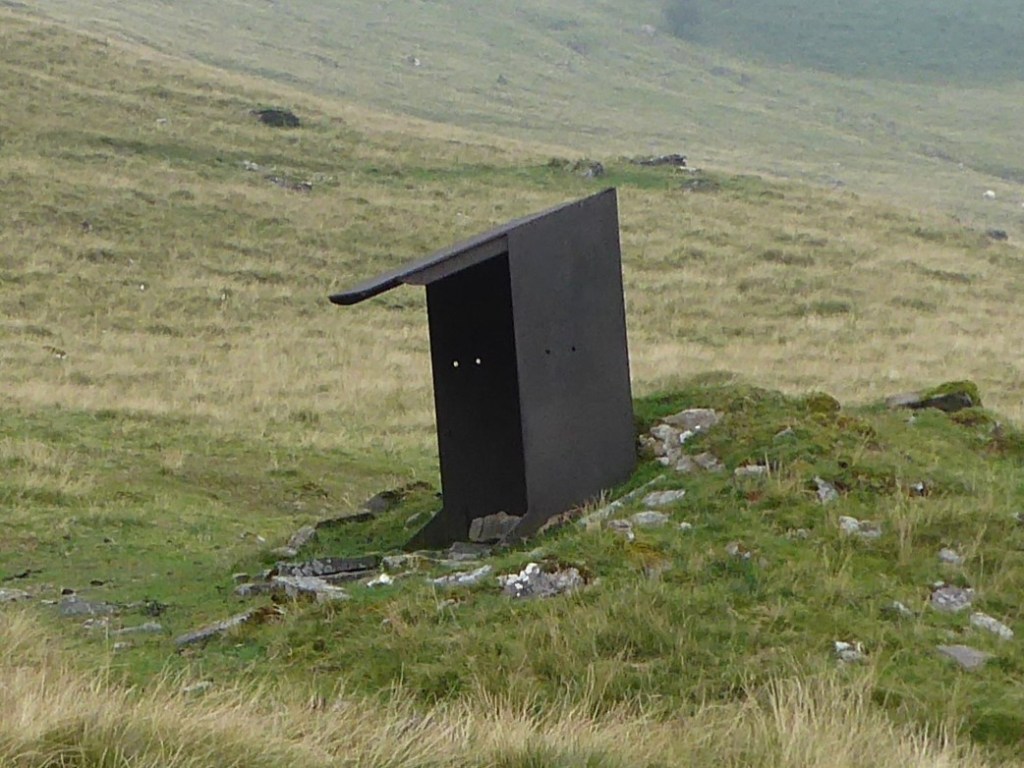
This iron mantlet is from a rifle range in the Brecon Beacons. It is of an unusual type, but gives an impression of the simple form that they can take. The most common type was made up of the same plates that were used for the targets.
The first firing point at 100 yards is where the current targets are situated. Shooting in the early days would have been done standing, out to 300 yards, and after that kneeling was permitted. The locations were marked with posts at 50 yard intervals, out to 600 yards. Unfortunately, nothing of the early range survives, having been erased during the various evolutionary upgrades that the site later underwent.
Sir Percy Burrell, Lieutenant of the 18th Sussex RV was no doubt mindful of the great distance he and his men in the northern catchment area of the 18th had to travel to get to Steyning to practice musketry. The distance between Knepp and Steyning is 10.5km (6.5 miles) as the crow flies, and this might not seem a great distance, but on unmade country roads, this was quite an excursion to make. Rifle Volunteers were bound to put in one month training a year (the actual arrangement of how these days were spread through the year was organized was left to the corps), which was a considerable outlay for working men, so to spend a large part of your ‘training’ day travelling was probably not viewed with relish. The opening of the Steyning railway line in 1861 would have saved a great deal of time travelling to Steyning range, but Lieutenant Burrell had a better idea: to open a second rifle range for the 18th on his own land at Knepp.
Knepp Rifle Range
The rifle range at Knepp was inaugurated in June 1863, with Lady Burrell firing the first shot, at 100 yards (and scoring a bull’s eye) and on October 3rd of the same year, the annual prize shooting was held here. The Horsham, Petworth, Midhurst and Steyning Express and the West Sussex Gazette, both reporting on the event, describe the butts in glowing terms, suggesting they “cannot be surpassed by any in the county” and that “we cannot see how it is possible a better plan could be formed for shooting practice”. A marker’s shelter was built into the bank on the right of the targets, with a single iron target placed at the base of a deep cutting in the slope. The considerable amount of material excavated from this cutting was deposited at the top of the slope, above the target, to form a crescent shaped stop-butt mound. There are two ‘shields’ marked on the map, another term for mantlet, although only one target seems to be marked. The reason for this could be that the eastern mantlet, which was built into the slope, did not provide a full scope for signalling with flags, so the western mantlet may have been later constructed on the flatter area, so flag signalling could proceed unobstructed.
The Knepp range offered a greater distance at which to practice musketry than Steyning (900 yards rather than 800 yards) and the location of the firing points and target on the river flood plain, ensured the site was level (at Steyning the targets were on higher ground than that of the firing points). These factors, not to mention the close proximity to the Captain’s residence, seem to have made Knepp the predominant range for the 18th over the next few years.
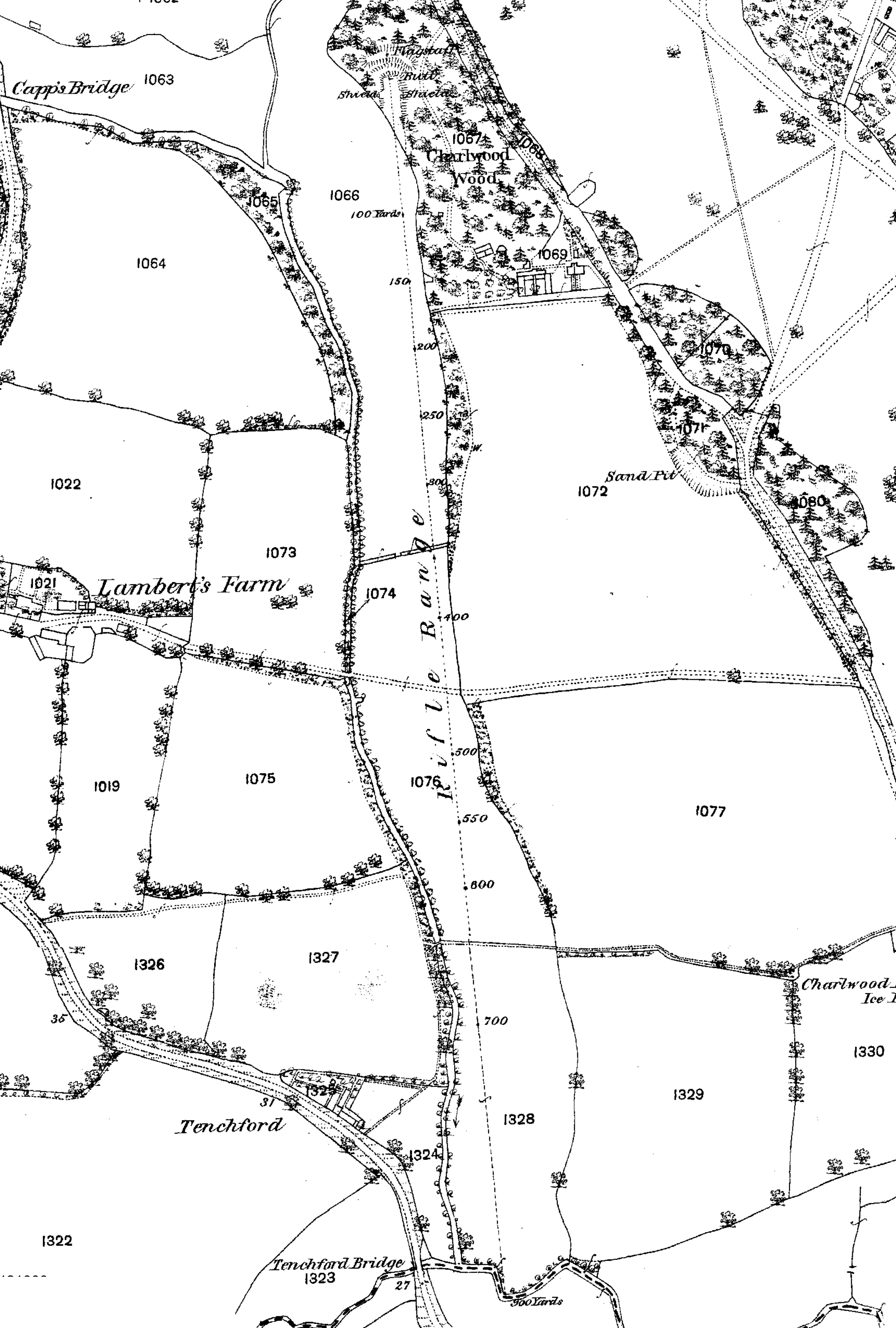
1875 25 inch Ordnance Survey map
Sir Percy Burrell resigned his commission in 1873 and the following year the annual shooting match of the 18th Sussex returned to Steyning range, which seems to have kept a low profile in the local press, since the Sussex Express article in 1861. Rifle practice and shooting matches continued at Knepp for a few years after this, though the reporting of matches and practice at Steyning is on the rise.
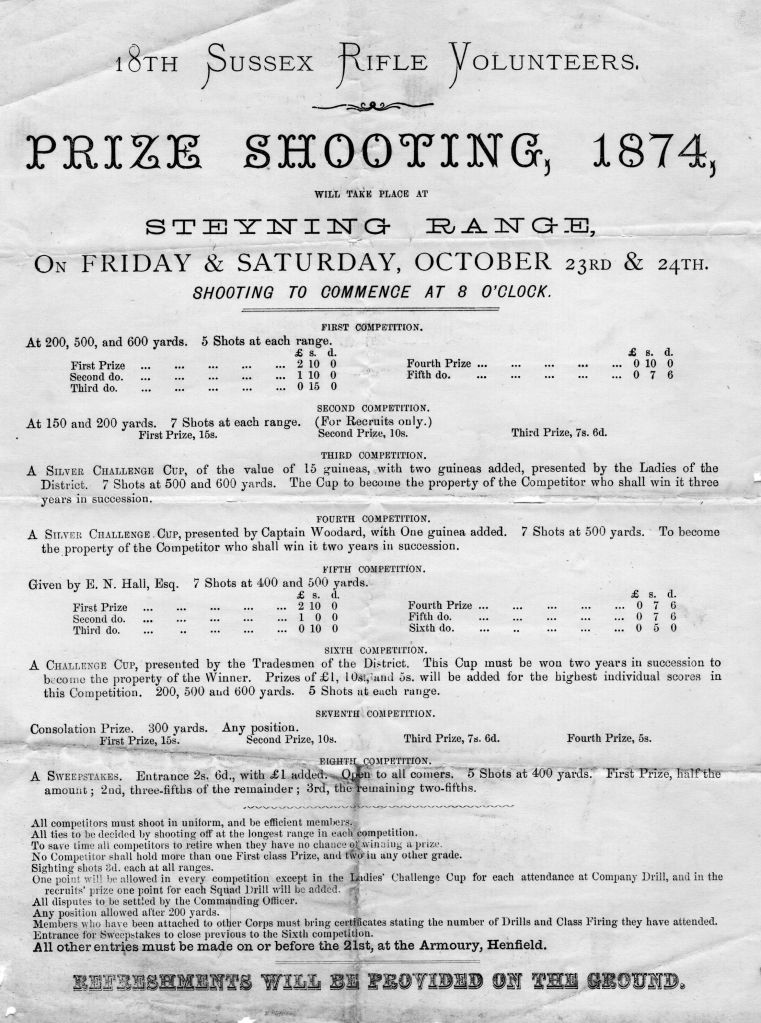
The final time the Knepp range is mentioned is in relation to the annual shooting match, on Sept 4th 1877, referenced in an advertising flyer and in the write up of the event in the Southern Weekly News. The Knepp Estate was now in the hands of Walter Burrell, Percy having passed away in 1876.

Steyning returns to being the main range
Steyning was once again the sole rifle practice location of the 18th Sussex RV, and there are many newspaper reports from the period, starting in 1874 and continuing through to the start of the Second World War. The P53 Enfield rifles that the Volunteers were initially issued with were long gone, replaced by the Snider from 1870 and followed by the Martini Henry in 1885 (issued a considerable time after the army received theirs).

Snider.

Martini Henry.
The iron target seems to have remained in the original location until 1893. In an article in the Sussex Agricultural Express, Rev John Goring is thanked in the dinner after the Henfield Fat Stock Show, ‘for his great kindness in renovating the range, at his own expense, for the local company’. It is probably at this time that the target location is moved to the east, and, as depicted on the 1897 25 inch OS map, it appears to be a small two target gallery, most likely holding two wooden target frames, with penetrable targets.
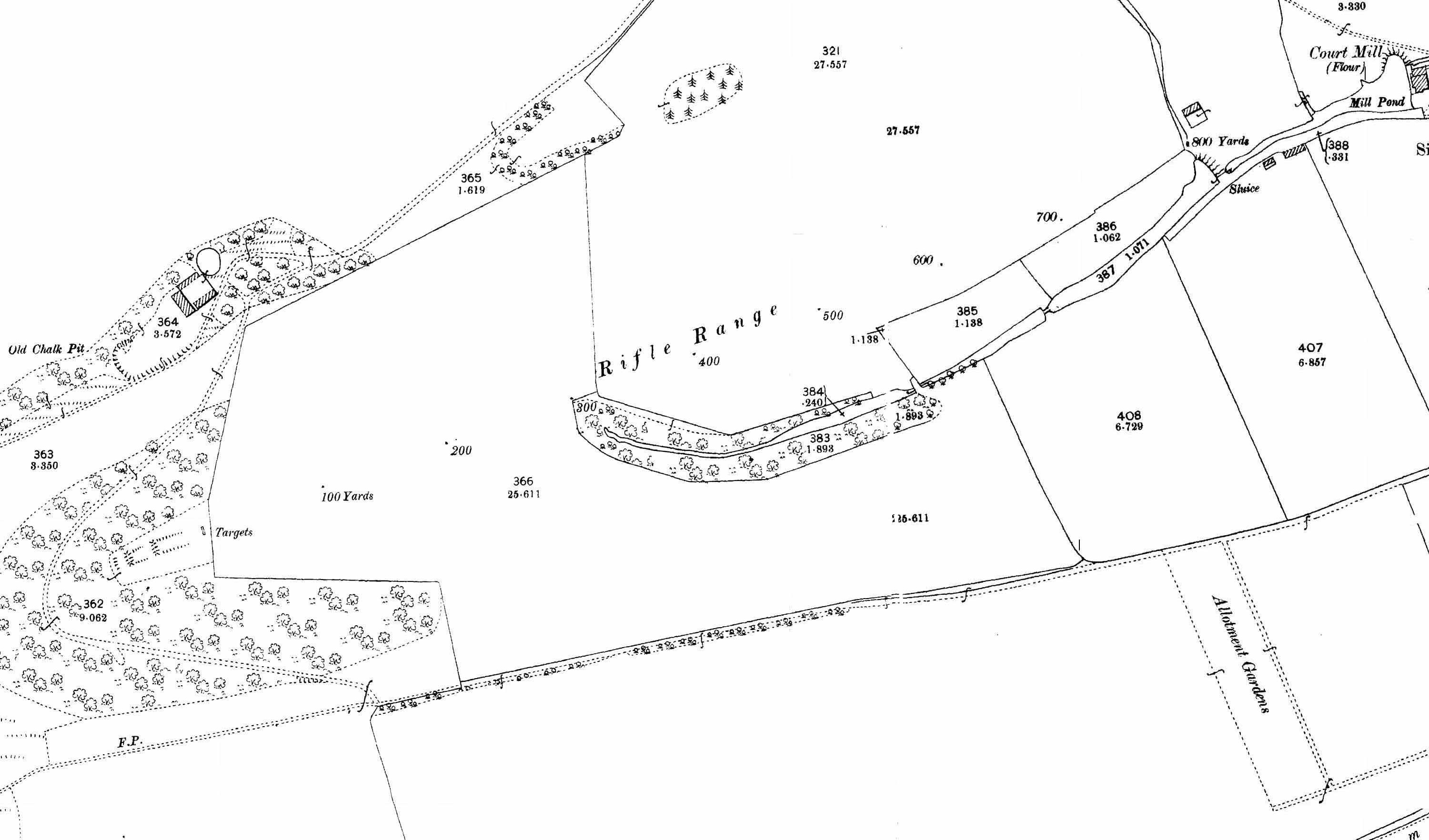
1897 25 inch Ordnance Survey map
It will be noted that the targets now occupy the position of the former 100 yard firing point, which provided a more level area for the target gallery to be constructed in. Being further down the slope, the backstop is no longer as steep as it was for the earlier range, so a series of terraced steps have been sculpted into it – a near vertical face is the ideal for a back stop, the lower the slope angle, the higher the potential of ricochets. The steps present vertical faces in short sections. The range now extends to 800 yards, the furthest recorded firing point, taking it very close to Court Mill. The other firing points have moved in tandem 100 yards east.
1897 is also the year that the Lee Metford rifle is issued to the Volunteers in Sussex, an event which throws rifle practice by Volunteers across the UK into turmoil. Firing a .303 jacketed bullet, the Lee Metford (and later Lee Enfield rifle) had a much greater range than the Martini Henry, requiring an increased danger area to the rear of the targets, of up to 2500 yards. The Select Committee report on rifle ranges and their use by the Magazine Rifle (as the Lee Metford/Enfield rifles were referred to), signs the end of many ranges, listing 159 ranges for use by regular troops (Volunteer ranges are excluded in the report), of which just 42 that were safe (or could be made safe) with the new rifle. The same review took place for Volunteer ranges and many of those in Sussex were closed. Steyning was fortunate in this respect, having the steep, high scarp slope of the south downs to the rear as a natural backstop and therefore classed as safe for use.
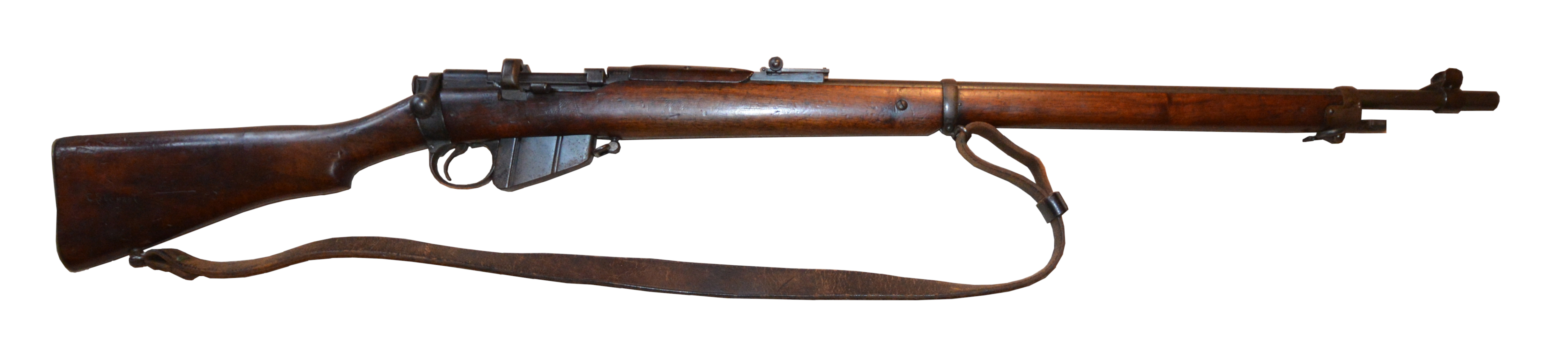
A Charger Loading Lee Enfield rifle. Although converted from the Long Lee Enfield around 1907, this rifle is broadly similar in dimensions and shape to the Lee Metford and Lee Enfield Magazine rifles.
Early 20th century
The 18th Sussex RVs were to become ‘L’ company of the 2nd Sussex RVs in 1880 and in 1903, ‘B’ company of the 2nd V.B Royal Sussex Rgt. In 1908 their name was to change again, with the dissolution of the Rifle Volunteers and creation of the Territorial Force. The former ‘B’ company, from Steyning and Henfield, were merged with Horsham (‘E’ company) or Arundel (‘F’ company)of the 4th Battalion Royal Sussex Regiment. The ‘E’ company from Horsham retained the use of Steyning rifle range.
The next recorded upgrade of the rifle range comes in 1913, when the Territorial Gazette reports that ‘subject to War Office approval, a tender of £166 111s, has been accepted, for alterations to the Steyning range’. This is likely the date that the initial two Hythe pattern target frames are inserted. These two Hythe frames are still present, the floor associated with them and the original markers’ gallery also still visible in the current gallery.
The First World War brought great changes to the South Downs, especially with the formation of Shoreham Camp and the thousands of soldiers trained there. Steyning rifle range, however, did not play a part in the New Army training, as those troops had four of their own ranges north of Shoreham. The Territorial army continued to train at Steyning and in 1915 a note in the West Sussex County Times and Standard comments that ‘arrangement can now be made for shooting at Steyning’ for the Sussex Volunteer Training Corps. The VTC were a rethink of the Rifle Volunteers, a part time army made up of civilians, for use in defence. Men of the Territorial Army had been given the option to go the France to fight in 1914, meaning that the TA was no longer solely a home defence force, and numbers had to be found to fill the gaps in home defence. The Volunteer Training Corps was the answer to the problem. They were initially poorly equipped but rifles and uniforms did eventually make their way through and it seems by 1915 there were enough rifles to begin musketry training.
Post 1935 upgrade and the Second World War
On January 17th 1935 the South of England Advertiser reports that the War Office would not agree to an upgrade of Steyning or Wellcombe Bottom ranges, but recommended ‘that no steps be taken for at least a year to extend range accommodation’. The extension from 2 to 8 targets seems to have occurred some time between 1936 (one year on from the article) and 1940, when an aerial photograph shows the markers’ gallery in a very similar format to its current arrangement.
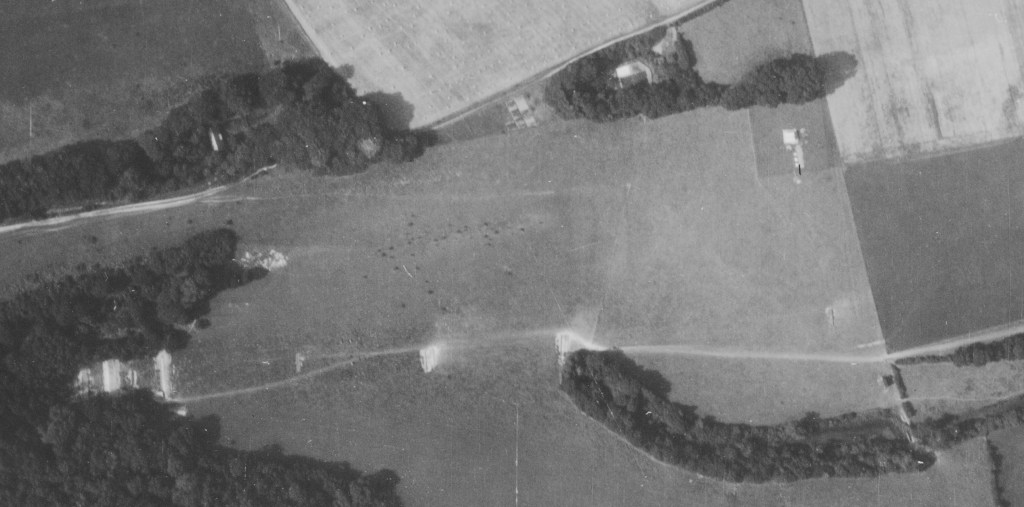
Aerial photograph, 15th April 1940.
The photograph above, from 15th April 1940 seems to show the site freshly made, perhaps even under construction. The 200 and 300 yard firing points look remodelled, while the 100 yard firing point shows activity, but not recent construction. The 500 yard firing point looks barely used. Also visible is a wardens hut, below the 500 yard firing point, and the gas training building directly above (in a square bordered compound just beneath the trees). Note the backstop and mantlet look newly sculpted and there is possibly evidence that only the four southern most target frames are in place. The protected entrance has not yet been built, nor has the turning circle.
By 1941 the backstop has acquired the distinctive banks and furrows, the turning circle has been added and the 100 yard firing point has been lengthened.

Aerial photograph, 1941
Derek Hunnisett, of the Royal Sussex Regiment (http://lost6years.hunnisett.me.uk/chapter03.php), recalled visiting the range for a week, from New Year’s Eve, 1939 and refers to training with rifle, Bren gun and anti-tank rifle. The later of these was the Boys anti-tank rifle, at that stage in the war the only infantry anti-tank weapon.
On May 14th 1944, an artillery training event of the South Downs had disastrous consequences, when 13 shells fell in and around Steyning. One of these landed amidst a group of Home Guard, completing their gas training, at the hut near the 500 yard firing point. As part of their military education, of which rifle target practice was just one element, the Home guard were drilled in the use of respirators and gas warfare. ‘Gas’ (smoke or tear gas) would be pumped into the building, men would enter with respirators fixed and some form of exercise might then proceed to take place – running on the spot or jumping, to simulate the effects of gas and smoke under battle conditions. For the remaining few seconds in the chamber, respirators were removed and the full effect of the toxin was experienced, as it was inhaled into their lungs. Their training over, the men would recover on the grass outside as others within their platoon went in for their turn. There were 40 to 45 men in the compound around the gas hut, when a shell exploded. One man, Private Leslie Wylie was killed and two others (Corporal Lindfield, of Maplehurst and Lieutenant Greenwood, of Partridge Green) were seriously injured. A boy of 16 was, Arthur Chandler, was also killed, in Steyning, while gardening in the Thornscroft area. An article on the inquest to the event, in the Shoreham Herald, from May 19th 1944, notes that 13 shells fell in the Steyning area, 8 of which exploded. One of the shells that did not go off, one landed at the gas works. Civil defence authorities tried to get in touch with the units on the Downs: Lieutenant William Marshall, senior gunnery officer, was leading the firing from a unit of tanks, stated ‘a despatch rider reported that mortar bombs were falling on Steyning. This was no concern of mine, but as an extra precaution, the range was lowered‘. In the confusion, the shells in Steyning were initially reported to be mortar bombs Lieutenant Marshall noting ‘the shells we were firing bore no relation to mortar bombs‘. Police Inspector Leonard Davis found one of the unexploded shells in the Cricket Field and later showed it to an army officer, who declared it to be a 75mm shell. The tragic incident highlights the perils that the civilian population was under in wartime, not just from enemy action.
After the war a number of ranges were closed, including Battle, Arundel and Cocking, but Steyning and Kithurst (Storrington) were retained (Sussex County Rifle Association 1861-1961). To bring the range up to date, various alterations were made. These included the addition of a concrete roof to the markers’ gallery (which meant lowering the brackets supporting the roof, to accommodate the extra thickness of the concrete), and adding new elements such as the protected entrance, the workshop platform and latrine to the south of the markers’ gallery. A second set of latrines were constructed near the warden’s hut at the 500 yard firing point. Firing trenches were dug at the 300 yard firing point, to allow shooting from trench conditions.
In 1969, during a discussion in the House of Commons on the closure of full bore rifle ranges, 52 ranges are listed as having being closed in the previous four years, to Army Cadet Forces, although Steyning is one of fifteen to be retained for use by schools and rifle associations.
In the early 1980s the lease of the range was taken over by the Adur Valley Gun Club, who cleared up the site (it seems to have fallen into decay in the late 1970s) and used it throughout most of the 1980s. Schools, the police, historic gun clubs and many other groups continued to use the site, the period well documented by Steve Handerer, the range warden up until 1987. Steve has provided many of the images in the historic photographs section and much useful information, and we are indebted to him for his help. In the last couple of years of use, the 100 and 200 yard firing points were extended and the 300 yard firing point was widened, not necessarily to accommodate more shooters (there were still only eight target frames) but to provide space for all the baggage guns and spectators that came to shooting events. In the late 1980s, the range was finally closed to full bore shooting, safety requirements having changed dramatically over the previous twenty years. The South Downs Way, just 800m west of the targets and Steyning, a similar distance to the east, meant the range was no longer viable under new regulations. After almost 130 years, the rifle range was at last to fall silent.
 Steyning Rifle Range